 Fate & Stars
Queen of Wands Tarot Card Meaning: Upright and Reversed
Queen of Wands meaning at a glance
The Queen of Wands represents confidence expressed through warmth, creative participation and a willingness to be visible. Upright, it asks how you can take part wholeheartedly without making approval the goal. Reversed, it can invite reflection on comparison, depleted enthusiasm or the urge to control how others respond.
Things You Should Know
- The Queen of Wands makes interest visible. Her living wand and sunflower can prompt you to contribute something you care about instead of waiting to feel impressive enough to begin.
- Warmth and independence can coexist. An encouraging presence gives other people room to participate in their own way, including disagreeing or choosing a different activity.
- Reversed confidence may become dependent on applause. Notice when a worthwhile activity loses its value because the audience is quiet, or when reassurance becomes a demand for constant attention.
- The black cat complicates a purely public image. In our interpretation, it leaves room for instinct, privacy and preferences that need not be explained to everyone who sees you.
- A queen describes a possible style of participation. The card does not determine someone's gender, appearance or zodiac sign, and cannot confirm a rival's jealousy or a partner's attraction.
Upright Queen of Wands meaning
The upright Queen of Wands encourages wholehearted involvement in something that interests you. Her seated confidence suggests that presence need not be frantic or loud. You might introduce a topic you enjoy, demonstrate a skill or invite someone into an activity you already find worthwhile. Ask what you would contribute if earning admiration were not the task. That question gives confidence a practical starting point.
Warmth becomes useful when it opens space for other people. A confident host notices who has not had a chance to speak; an expressive collaborator shares an idea without deciding every detail of the response. The queen's authority is not diminished by another person's contribution. In an advice position, look for a way to make your enthusiasm legible while leaving the exchange open enough to surprise you.
In love, this card can frame an attraction expressed through clear interest and an independent sense of self. Invite someone to spend time together because you would enjoy their company, then let their answer be theirs. For an established relationship, ask whether both people have room for friendships, creative interests and forms of expression they do not share. Closeness need not require identical tastes or continuous attention.
At work, the queen may describe presenting a proposal with enough conviction to help others understand why it matters. Explain the purpose, offer a concrete way to join and share ownership when someone contributes. For resource questions, examine whether a choice serves an interest you can name or maintains an image you feel expected to project. Enthusiasm can clarify priorities, but cannot calculate affordability or establish the quality of an offer.
Queen of Wands reversed meaning
The Queen of Wands reversed can describe the strain of maintaining a confident appearance when enthusiasm has faded. You may be known as the person who energizes every gathering and feel unable to admit you would prefer a quieter role. Ask what part of participation still interests you and what part is a performance of who others expect you to be. A smaller contribution can still be wholehearted.
Another possibility concerns comparison. Someone else's attention, influence or creative output becomes the standard against which your own activity is judged. Notice what you stop enjoying when you begin counting responses. Choose one criterion within the work itself: a clearer presentation, a satisfying rehearsal or an honest exchange. Approval can be welcome without becoming the sole evidence that the activity deserves to continue.
In relationships, a need for reassurance may turn into attempts to manage another person's attention. Name the particular uncertainty rather than testing whether they will cancel plans or repeat a compliment. Alternatively, you may be suppressing your own preferences to remain appealing. Reversed queen advice asks whether warmth is still freely offered when neither person must constantly demonstrate loyalty through availability.
At work, review what happens when someone else receives credit or changes your suggestion. If disagreement feels like rejection, the team may be losing room to improve the idea. If your own energy is depleted, delegation may be a practical adjustment rather than a threat to your identity. The card cannot establish that a colleague is jealous; examine the behavior, the agreement and the effect on participation before assigning a motive.
Queen of Wands upright vs reversed by situation
The queen's theme is a relationship with visibility. Upright participation can be expressive and generous; reversed asks where comparison, depletion or control makes that visibility difficult to inhabit.
| Situation | Upright | Reversed |
|---|---|---|
| Love | Express desire while allowing independent interests and responses. | Discuss reassurance without requiring constant proof of attention. |
| Career | Present an idea and invite meaningful shared ownership. | Review defensiveness when someone changes the idea or earns credit. |
| Daily life | Join an activity because it interests you. | Reduce the effort spent maintaining an endlessly energetic image. |
Queen of Wands keywords
| Upright | Reversed |
|---|---|
| Warm self-assurance | Approval dependence |
| Expressive participation | Defensive visibility |
| Creative enthusiasm | Depleted motivation |
| Encouraging leadership | Controlled participation |
| Independent affection | Possessive reassurance |
| Welcoming presence | Comparison with others |
| Wholehearted contribution | Hidden preferences |
| Confidence with room to share | Fear of losing attention |
Queen of Wands in different questions and positions
Queen of Wands as advice
Imagine attending a creative gathering where you know nobody. Queen of Wands advice could mean choosing one topic you enjoy and asking another participant about their work. You do not need to dominate the room or remain until the end to prove confidence. Afterward, evaluate whether you expressed a real interest and made room for an exchange. This fictional scenario treats presence as participation rather than a performance with applause as its score.
Queen of Wands as an outcome
As an outcome, the queen can suggest becoming more comfortable contributing visibly or helping others engage with an idea. A successful workshop might leave participants willing to try something themselves. That is different from everyone admiring the presenter. Reversed, the event may attract attention while leaving its organizer dependent on praise or too depleted to continue the activity they originally enjoyed.
Queen of Wands in past, present and future positions
In the past, the card may recall encouragement that helped you become visible, or an expectation that you would always entertain and reassure others. In the present, examine how freely you can express an interest. In the future, consider the kind of participation you want to practice. The queen offers an approach you can develop, rather than a fixed identity you must acquire before taking part.
Queen of Wands in a yes-or-no spread
A useful question asks whether to share an interest, make an invitation or volunteer for a role you understand. Asking whether everyone will admire the result makes the answer depend on responses outside your control. Try the yes-or-no tarot reading with one proposed contribution, then ask whether you would still value making it without a guaranteed audience reaction.
Is the Queen of Wands a yes or no card?
For this guide, the upright Queen of Wands is a conditional yes to expressing an interest and participating with warmth. It fits an invitation you want to make or a skill you are ready to share. Include the actual commitment in the question so the answer concerns a role you can sustain, rather than an abstract demand to be more charismatic.
Reversed, we use clarify the approval or control the action depends upon. You may still choose to participate after reducing the audience pressure or changing the role. A yes-or-no prompt becomes clearer when it distinguishes offering something from securing admiration for it. This court card can frame your approach, while the people involved retain their own choices about how to respond.
Queen of Wands symbolism in the Rider–Waite–Smith deck
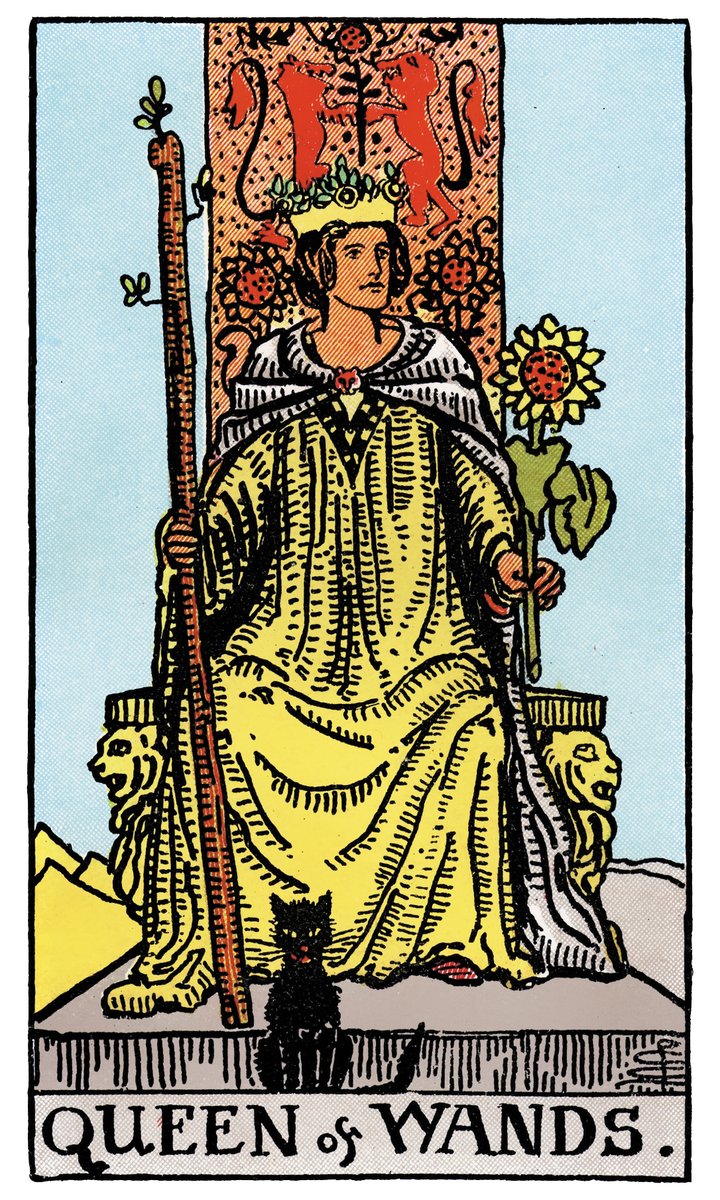
The queen sits on a throne decorated with lions, holding a wand with leaves and a sunflower. A black cat occupies the foreground near her feet. The composition combines a public seat of authority with lively, particular details. Our reading uses that combination to explore a presence that can be assured and receptive without requiring every aspect of the person to become a public performance.
Waite's Queen of Wands entry links the living wand with animation and describes a magnetic quality through the conventions of his period. His reversal includes favorable qualities as well as difficult possibilities that depend on surrounding cards. Our discussion of comparison and exhausted enthusiasm is a contemporary reading approach, not a direct reproduction of his whole divinatory list.
The sunflower gives the image a clear point of warmth, while the cat invites a different kind of attention. We read the contrast as room for both welcome and privacy. That is an interpretive use of visible details, rather than a claim that each object has one settled hidden definition. Reversed, ask whether your visible confidence leaves any space for an unperformed preference, an uncertain feeling or a wish to step back.
Frequently asked questions about the Queen of Wands
Does the Queen of Wands mean attraction?
Attraction can be a relevant context when the question concerns dating or desire. The image alone cannot confirm that someone is attracted to you. Look at how interest is actually communicated and whether both people have room to accept, decline or ask for something different.
What does the Queen of Wands mean as a person?
Use it to describe a style you recognize in the situation: an encouraging host, an expressive collaborator or someone comfortable sharing an interest. A person of any gender can use that approach. One court card does not summarize their whole character or establish what role they should occupy.
Is the Queen of Wands reversed a jealous woman?
That label makes both a motive and a gender assumption the card cannot establish. The reversal may instead concern your own comparison, a group's demand for enthusiasm or a contribution that feels difficult to make. Describe the behavior that needs attention before deciding whether jealousy is even a useful question.
Can an introvert be the Queen of Wands?
Yes; wholehearted participation does not require enjoying a large audience. A quiet demonstration, a thoughtful invitation or a warm conversation can express this queen's qualities. The relevant issue is whether you can contribute something that matters to you while staying interested in the other person's participation.
How does this queen differ from the King of Wands?
The King of Wands offers a comparison through direction and a vision others can work toward. This queen emphasizes the quality of expressive presence and encouragement within participation. Both approaches can be practiced by the same person, depending on what the situation requires.
What does Queen of Wands mean for you?
Already have this card? Choose its orientation and add your question. We’ll interpret this exact card in context, without drawing a different one.
One personalized interpretation uses one free reading. Subscribers get unlimited readings, follow-up questions, and supplemental cards. Your reading stays private.
Queen of Wands
For reflection and personal insight. Your choices shape what comes next.
A question to take with you
Confidence can make room for warmth and independence without needing to dominate the room. Where would a more deliberate use of my energy help?
Explore a question with the cards →These are contemporary reflection prompts, not a single definitive meaning. For historical background, see A. E. Waite’s The Pictorial Key to the Tarot. Interpretations vary with the reader and the context.