 Fate & Stars
Four of Swords tarot card meaning
Four of Swords meaning at a glance
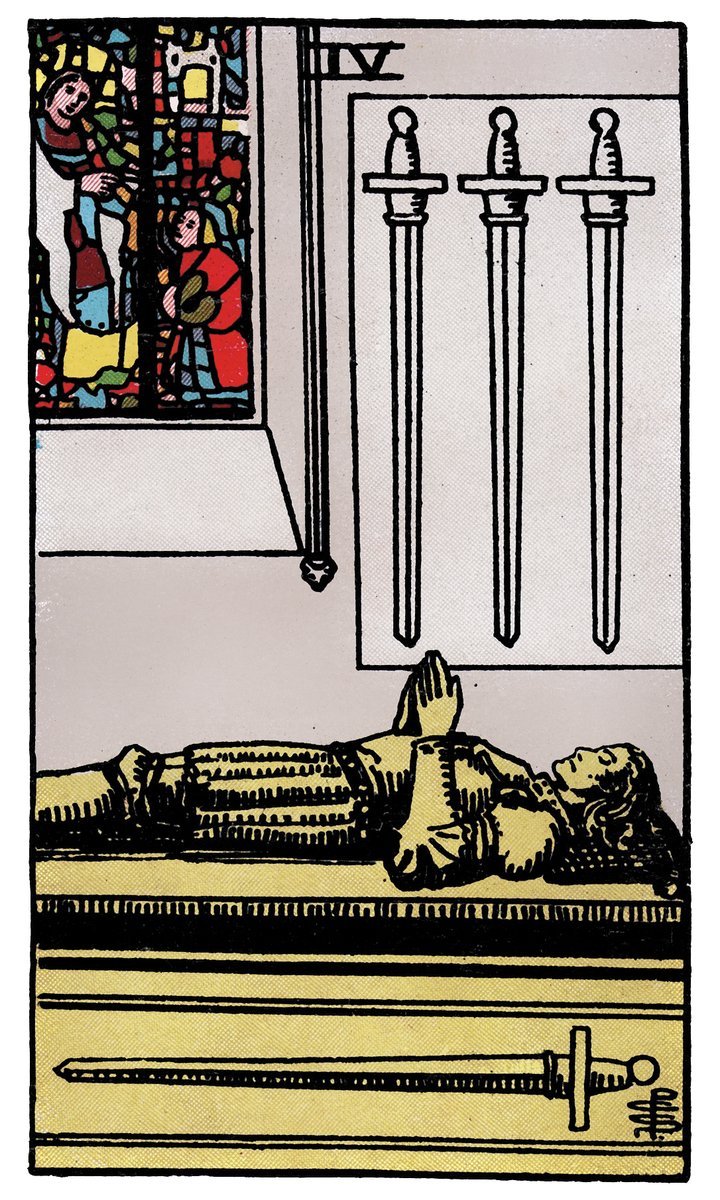
The Four of Swords means a deliberate pause for rest, recovery and perspective. Beneath three hanging swords, a knight lies still with one sword below, placing action temporarily aside. Upright, protect space to recuperate; reversed, examine restless recovery or readiness to return. Its stillness does not require permanent withdrawal from life.
Things You Should Know
- The resting knight models a pause with a purpose: reduce demands long enough to recover judgment and available energy.
- Three swords remain on the wall, so retreat does not erase the issue that made rest necessary in the first place.
- The single sword beneath the figure suggests keeping one clear priority instead of trying to resolve every concern during a break.
- Reversed, the same quiet chamber can describe interrupted rest, an uneasy return or a retreat that needs a gentler endpoint.
- The tomb imagery belongs to the historical design; drawing this card does not establish illness, death or a fixed recovery timetable.
Upright Four of Swords meaning
The Four of Swords upright asks you to stop treating every moment as an opportunity to respond. The knight is not holding any of the blades, and that separation matters. You may need time away from debate, notifications or a decision that you keep reconsidering without new information. A useful pause changes the conditions around you; simply thinking about the same problem in a quieter room may not provide the relief you need.
In love, the peaceful chamber can represent an agreed interval after a difficult conversation. Explain when you will reconnect so that space does not become unexplained disappearance. A couple might leave a disagreement until the next evening rather than continue when both are exhausted. Like the three swords still visible above the knight, the issue remains acknowledged without demanding immediate attention.
At work, the sword below the resting figure offers an image of reserving one essential responsibility while other tasks wait. Arrange coverage, reduce the number of open decisions or finish the handover before taking leave. The upright card supports recovery as a present need, rather than making rest another performance goal. You do not have to promise exceptional productivity afterward to justify stepping back from an overloaded schedule.
Four of Swords reversed meaning
The Four of Swords reversed can describe wanting the knight to rise before the pause has done its work. You may be technically away from work while answering messages all day, or taking a free afternoon while feeling compelled to justify it. The wall swords have effectively followed you into rest. Look for one demand that can be removed, delegated or given a later response time.
Another possibility is that the quiet chamber has become too difficult to leave. What began as a helpful retreat may now feel like the only manageable setting. The single sword beneath the figure can suggest one modest point of reentry: a short conversation, a limited task or a familiar routine. Returning gradually is different from declaring that you must resume every previous obligation immediately.
The reversal can also mark renewed readiness after genuine recuperation. Imagine the resting knight considering which sword to pick up first, rather than springing straight into battle. Check what has changed in your capacity and surroundings. If the same pressures remain, returning without a different arrangement may recreate the need for retreat. The reversed card asks for a workable transition, not a verdict that your rest has failed.
Four of Swords upright vs reversed by situation
| Situation | Upright | Reversed |
|---|---|---|
| Love | An agreed pause that allows a calmer conversation | Restless distance or readiness to reconnect gradually |
| Career | Leave, reduced demands or reflection before the next commitment | Interrupted recovery or a return needing better boundaries |
| Daily life | Fewer inputs and one simple priority | Difficulty settling or a retreat extending beyond its purpose |
The knight and four separated blades distinguish setting action aside from abandoning it. To interpret the orientation, ask whether the pause is restoring choice or whether demands are leaking into it. Neither row turns quietness into proof that someone has stopped caring or predicts exactly when momentum will return.
Four of Swords keywords
| Upright | Reversed |
|---|---|
| Deliberate stillness | Rest interrupted |
| Recovery space | Gradual reentry |
| Mental respite | Uneasy inactivity |
| Protected reflection | Capacity reassessed |
The three wall swords help keep these terms specific: concerns can remain real without remaining active all day. The fourth blade below the knight suggests narrowing attention rather than solving the whole future. Choose the keyword that describes your current relationship with demands, and resist turning recovery into another deadline against which to judge yourself.
Four of Swords as advice, outcome and spread positions
As advice, the sheltered knight invites a practical reduction in stimulation. In a fictional example, Arun keeps reopening an argument with his sister through late-night messages. He suggests a weekend call, writes down the point he wants to understand and stops drafting replies during the interval. His pause resembles leaving the swords on the wall: he has not denied the disagreement, but he has stopped continuously handling it.
As an outcome, the resting scene can suggest that a situation becomes quieter before it becomes resolved. A project might enter a waiting period after a demanding delivery. Consider how you would use that interval without immediately filling it. The chamber offers space for recovery and reflection; it does not promise that a delayed answer will be favorable or that all conflict has ended.
In the past position, the knight can recall a necessary withdrawal that helped you survive a demanding season. In the present, ask whether there is actual room to rest. As an obstacle, the unmoving figure may suggest postponing a small return that is now possible. Beside the Three of Swords, acknowledge the hurt before deciding what recuperation requires. Beside the Eight of Wands, protect a pause even when communication around you accelerates.
Is the Four of Swords a yes or no card?
The Four of Swords usually suggests wait when a question asks for immediate action. The knight has deliberately set the swords aside, so a rushed commitment works against the image. For a question about taking a break or postponing an unproductive discussion, the card can lean yes when you also communicate what needs to happen during the interval.
Reversed, the single sword beneath the knight makes a smaller question useful: are you ready for one limited next step? Consult the yes or no tarot guide to frame that action clearly. A quiet card cannot determine another person's intentions, and its reversal cannot certify that your capacity has returned simply because you want movement.
Four of Swords symbolism in the Rider–Waite–Smith deck
Pamela Colman Smith's image shows a knight's effigy lying with hands together, three swords above and one below, beside a stained-glass window. In Waite's Four of Swords entry, the figure is explicitly an effigy on a tomb. His upright associations include retreat and solitude; the reversed list emphasizes careful administration and precaution among other terms. These historical details explain the solemn setting without making it a literal forecast.
Reading the chamber as a space for restorative rest is a contemporary application of the image. The wall swords remain nearby, while the figure is no longer wielding them. That distance can represent suspending argument or analysis. The window gives the enclosed setting a point of light and attention beyond the blades. Neither the tomb nor the number four provides a diagnosis or a duration for how long a pause should last.
Frequently asked questions about the Four of Swords
Does the Four of Swords mean a breakup?
The knight's separation from the swords can suggest temporary distance, but the scene does not show two partners ending a relationship. An agreed pause may support a bond when conversation has become exhausting. Ask what the distance is for, whether both people understand it and when contact will resume instead of treating stillness as a final answer.
Is the Four of Swords the same as doing nothing?
The resting figure models intentionally setting action aside. That can involve arranging coverage, declining a demand or creating an interval without constant input. The sword below the knight reminds you that a purpose remains. A pause becomes useful through the room it creates, even when it produces no visible achievement to display afterward.
What does the Four of Swords reversed mean at work?
It can describe returning from a break, struggling to disconnect or remaining withdrawn after a difficult assignment. Picture the knight deciding whether to rise and which blade to take first. Examine your actual workload and available energy before choosing among those readings. The orientation alone cannot tell you that a demanding schedule is manageable again.
How is the Four of Swords different from the Hermit?
The Four centers on a reclining figure whose weapons have been placed aside, emphasizing respite from demands or conflict. The Hermit's standing figure and lantern more readily suggest an active search for insight. Rest and inquiry can overlap, but the Four asks whether you need less engagement before trying to understand everything more deeply.
Can the Four of Swords suggest a helpful daily practice?
Yes: let the four separated swords inspire an interval in which unresolved matters stay written down rather than continuously rehearsed. You might leave your phone outside a quiet space or postpone a recurring discussion until an agreed time. Choose a realistic pause that reduces demands instead of adding a complicated routine you must perform correctly.
What does Four of Swords mean for you?
Already have this card? Choose its orientation and add your question. We’ll interpret this exact card in context, without drawing a different one.
One personalized interpretation uses one free reading. Subscribers get unlimited readings, follow-up questions, and supplemental cards. Your reading stays private.
Four of Swords
For reflection and personal insight. Your choices shape what comes next.
A question to take with you
Rest is an active part of recovery, especially when another decision would otherwise be made from depletion. Which assumption could I check against observable evidence?
Explore a question with the cards →These are contemporary reflection prompts, not a single definitive meaning. For historical background, see A. E. Waite’s The Pictorial Key to the Tarot. Interpretations vary with the reader and the context.