 Fate & Stars
Death tarot card meaning
Death meaning at a glance
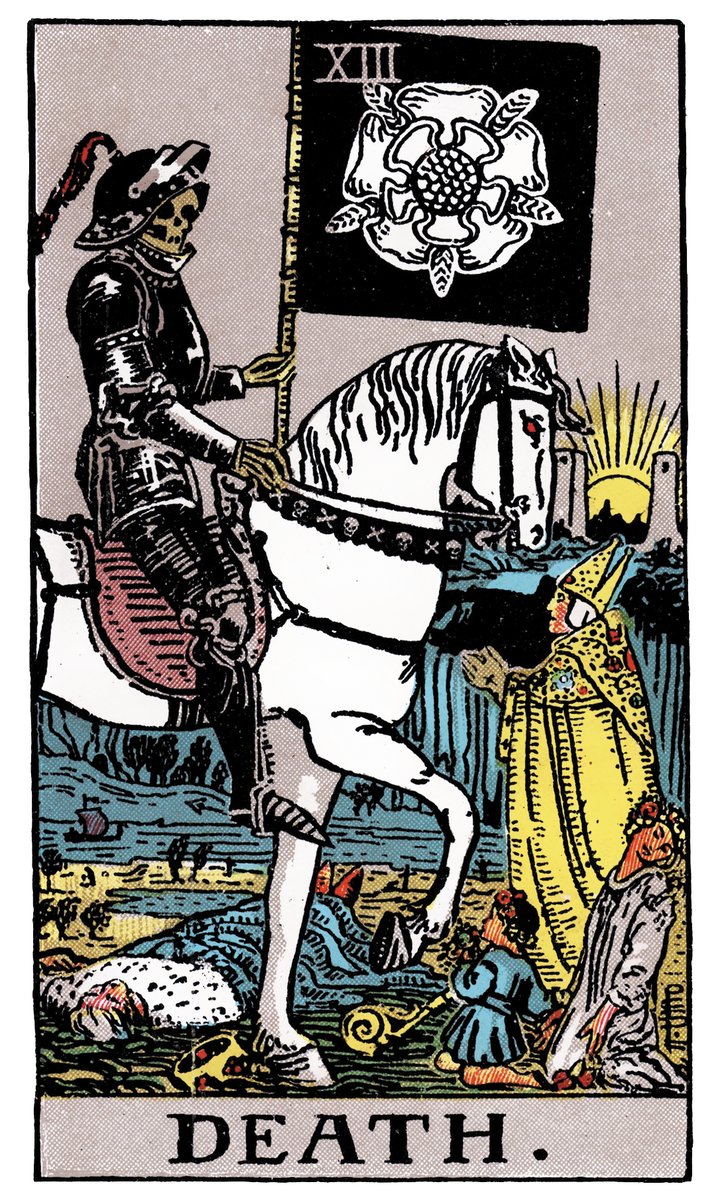
Death tarot card meaning centers on endings, release and a change of form upright. Reversed, it can show resistance to an ending, a prolonged transition or the private work of letting go. The armored rider and horizon light frame a passage; this card is not evidence that a person will physically die.
Things You Should Know
- Death asks what has reached its limit. An expired role, agreement or habit may require an actual ending before a different arrangement can take shape.
- The reversal can slow the passage. Holding on may postpone discomfort while keeping the old demands alive; gradual release is another possible expression.
- The rider meets people of different stations. The fallen crown suggests that status and bargaining cannot preserve every familiar structure indefinitely.
- The white rose on the black banner complicates the frightening image. The design places life within the symbolism of ending, without requiring loss to feel welcome.
- Interpret Death as a reflective symbol, not a mortality forecast. Neither its orientation nor nearby cards can establish a medical outcome or someone's lifespan.
Death upright meaning
Upright Death often names the part of a situation that cannot continue in its existing form. You might be leaving a job identity behind, ending a recurring argument by changing the agreement beneath it, or acknowledging that a plan no longer fits your life. The useful question is specific: what must stop, and what responsibilities remain during the transition?
The rider moves through the scene with an impersonal steadiness. A fallen king and other figures appear before the horse, making rank an inadequate defense against change. In a modern reading, this can challenge the belief that sufficient effort, prestige or persuasion will restore a chapter that has already closed. Acceptance is not approval of everything that happened; it is recognizing the present conditions clearly enough to respond.
In love, Death can mean an obsolete relationship pattern needs to end. A couple may stop organizing every decision around an old grievance, or admit that their previous expectations no longer work. Sometimes the relationship itself is ending, but the question and actual circumstances must support that interpretation. An evocative image is not a breakup instruction.
At work, consider discontinued services, a role handover or a professional identity that no longer describes your contribution. Plan what needs archiving, returning or communicating. For daily life, the card can favor retiring a commitment rather than endlessly optimizing it. The horizon's light leaves room for continuation, but the present task may simply be making a respectful ending. You do not have to identify an exciting replacement before admitting something is finished.
Death reversed meaning
Death reversed may describe a transition held in suspension. You have announced a change but keep accepting the same duties, or you have left a relationship while continuing its daily emotional negotiations. Notice the actions that keep the old form functioning. A clean boundary might involve changing a schedule, returning access or making an overdue handover explicit.
Resistance can be understandable. The familiar arrangement may have supplied income, community or a sense of competence. Calling yourself stubborn skips those real attachments. Identify what the old structure provided and consider how each need could be supported elsewhere. That makes release more practical than demanding that you simply become fearless.
The reversal can also turn the process inward. From outside, little appears different, while privately you are relinquishing an identity or revising a long-held expectation. This slower interpretation fits situations where the external ending is already settled. It need not mean that you have failed to move on because your emotions have not followed a timetable.
In relationships, avoid reading resistance as proof that an ex secretly intends to return. Your unfinished attachment is not evidence of their plan. At work, check whether a supposedly temporary extension is becoming indefinite. Agree on what support, date or replacement would allow the transition to proceed. Reversed Death asks whether delay is serving a necessary adjustment or preserving a form that everyone continues to describe as finished. Sometimes compassionate pacing helps; sometimes another postponement only extends the cost.
Death upright vs reversed by situation
These contrasts focus on the mechanics of release rather than dividing change into lucky and unlucky outcomes.
| Situation | Upright | Reversed |
|---|---|---|
| Love | End a worn-out dynamic and define what follows. | Attachment or ambiguous boundaries keep the old dynamic active. |
| Career | Retire a role or process with a responsible handover. | A transition drifts because no one releases old duties. |
| Daily life | Stop maintaining a commitment that no longer fits. | Quietly grieve an identity, or examine why departure keeps slipping. |
Death keywords
| Upright | Reversed |
|---|---|
| Necessary ending | Prolonged departure |
| Release of an old form | Clinging to the familiar |
| Irreversible transition | Bargaining with an ending |
| Identity shedding | Private identity revision |
| Closure through action | Unclear exit boundaries |
| Space after cessation | Fear of the empty interval |
| Retirement of a pattern | Repeated postponement |
| Acceptance of change | Gradual disentanglement |
Death in different questions and positions
Advice when a project no longer serves its purpose
Imagine a volunteer group maintaining an event no one has time to organize. Death as advice could mean canceling that format respectfully, notifying participants and preserving useful contacts. It does not demand that the group disappear. The distinction between the living purpose and its exhausted container can help people stop confusing loyalty with endless maintenance.
An obstacle position during a transition
As an obstacle, Death can highlight what you are unwilling or unable to conclude. Name the attachment before choosing a remedy. Someone worried about losing colleagues needs a different transition plan from someone who has not completed documentation. Reversed, examine whether you are expecting the ending to feel emotionally painless before taking any practical step.
Past, present and future readings
In the past, Death may locate a decisive break that still shapes the current situation. In the present, it asks you to identify the change already underway rather than search for an unrelated catastrophe. In the future, it can suggest that the present arrangement will need revision or release if the current pattern continues. Future placement does not establish the date or nature of a loss.
Reading Death alongside a new beginning
When a spread includes both Death and a beginning card, resist rushing past the ending. An invitation may be promising while the old role still requires notice, grief or an orderly exit. Leaving space between chapters can be part of the work rather than evidence that nothing is happening.
Death Yes or No
Upright: No — the present form is unlikely to continue unchanged; an ending needs room.
Reversed: Maybe — resistance or unfinished release may be prolonging a transition.
Death's no is most direct when you ask whether an exhausted arrangement can simply carry on. For a question about stopping an obsolete habit or closing a chapter, its theme can instead support yes to release. State what would be ending before interpreting the answer as a verdict on your entire life.
Death reversed yes or no readings often concern what you keep maintaining despite recognizing that it no longer works. Identify an orderly final step, such as returning belongings or ending an outdated obligation. Consult yes or no tarot to frame the decision precisely. This card does not predict a physical death or establish an unavoidable relationship breakup.
Death in Love
Singles
Death in love may invite you to retire a dating pattern or an identity organized around a past relationship. That could mean ending intermittent contact, clearing space in your routine or admitting that your preferences have changed. You do not need to force a fresh romance to prove you have moved on. Let a genuine ending make room for choices that fit your present life.
Partnered
In a partnership, Death asks which arrangement cannot continue: a repeated conflict, an outdated role or, sometimes, the relationship itself. Discuss the concrete issue before assuming separation is inevitable. A revised agreement needs changed behavior from both people, rather than a ceremonial promise to start over. The love tarot guide can help focus the question on what each partner is prepared to relinquish.
Reversed
Reversed, Death may describe clinging to a familiar bond, delaying a necessary conversation or repeatedly reviving a relationship whose central problem remains. Mixed grief and attachment are understandable, but they do not prove that an ex intends to return. Ask what continued waiting costs and what closure you can arrange yourself. If a couple chooses renewal, specify the old behavior that ends and the new conduct that replaces it.
Death symbolism in the Rider–Waite–Smith deck
A skeleton in dark armor rides a white horse and carries a black standard bearing a white rose. The picture combines severity with signs of life. A crown lies near the fallen king, while a religious figure faces the rider and younger figures occupy the foreground. Read visually, authority and youth do not remove participation in change.
The distant sun appears between two towers. It gives the scene a horizon beyond the immediate encounter, without making the foreground gentle. That contrast supports a reading in which continuation and grief can coexist.
Waite's description of Death discusses spiritual transformation, the rose's association with life and a form of changed consciousness. Contemporary interpretations of job transitions and relationship patterns apply the image in everyday terms. They should not be presented as historical medical predictions or as proof that every painful ending was destined for a beneficial purpose.
Frequently asked questions about Death
Does the Death tarot card predict physical death?
A tarot draw cannot establish that someone will die. In a reflective reading, use Death to examine endings, changing identities and release. If your concern is someone's health, seek information from the people and professionals involved instead of treating this image as a diagnosis.
Does Death in a love reading always mean separation?
Separation is one possible context, but a relationship may also outgrow an old rule or conflict pattern. Ask whether both people want and can sustain a different agreement. The card cannot decide compatibility or substitute for what either partner actually says.
Can Death reversed mean an ex will come back?
It may describe difficulty accepting an ending, including your own difficulty. That is not confirmation of renewed contact or reconciliation. A return would require observable communication and choices from both people, not just an unfinished feeling in the reading.
What is the difference between Death and The World?
The World emphasizes completion and integration; Death emphasizes relinquishing a form that cannot continue. You can understand a chapter as complete and still need time to release its habits, duties or identity.
Is Death reversed yes or no?
Maybe usually captures a release that remains unfinished. If you ask whether an old arrangement can continue without change, resistance does not make that outcome sustainable. Look for the specific task or conversation you are avoiding before treating the reversal as permission to keep waiting.
What does Death mean for you?
Already have this card? Choose its orientation and add your question. We’ll interpret this exact card in context, without drawing a different one.
One personalized interpretation uses one free reading. Subscribers get unlimited readings, follow-up questions, and supplemental cards. Your reading stays private.
Death
For reflection and personal insight. Your choices shape what comes next.
A question to take with you
What has run its course, and what could replace it?
Explore a question with the cards →These are contemporary reflection prompts, not a single definitive meaning. For historical background, see A. E. Waite’s The Pictorial Key to the Tarot. Interpretations vary with the reader and the context.