 Fate & Stars
Five of Wands tarot card meaning
Five of Wands meaning at a glance
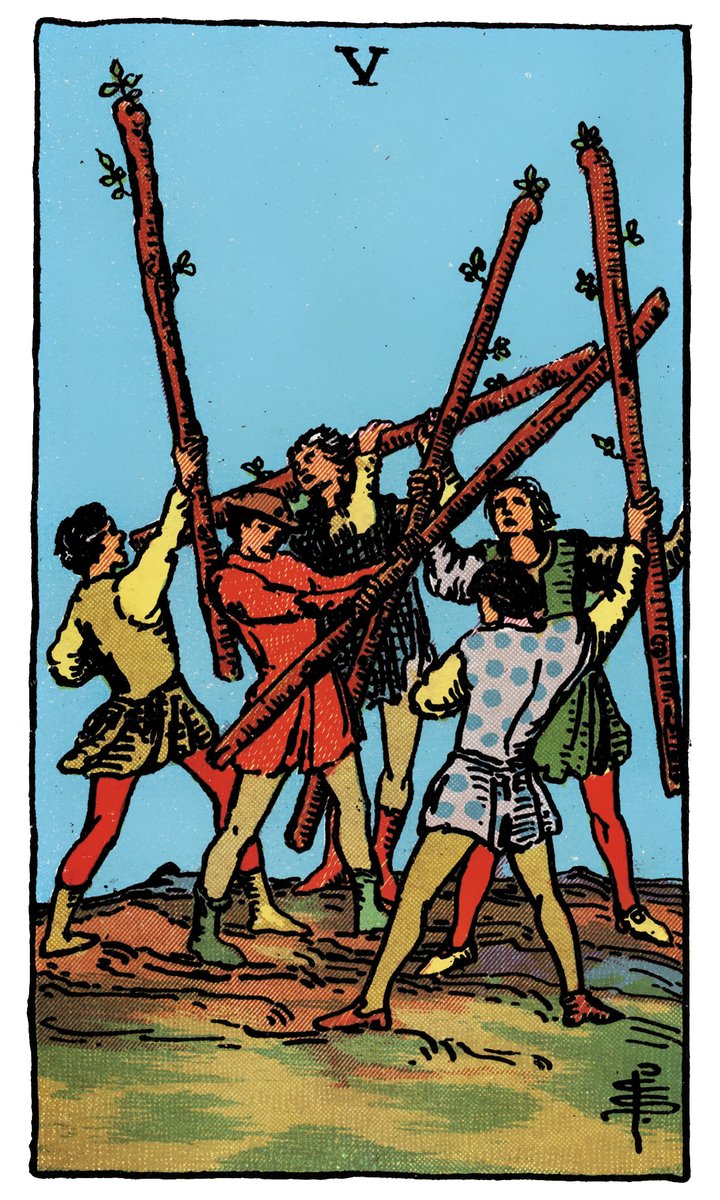
The Five of Wands means competing energies, friction and the challenge of coordinating people who want different things. Upright, it can describe lively contest or scattered effort; reversed, it may show de-escalation, avoided conflict or entrenched disputes. Five youths raise their wands without a clear winner, asking what rules would make participation useful.
Things You Should Know
- Friction does not identify an enemy. Several people may be trying to contribute while disagreeing about the goal, method or order of speaking.
- Competition needs an understandable frame. A contest becomes more useful when everyone knows the criteria, limits and way a decision will be made.
- The image has no settled winner. Drawing this card cannot tell you who gets the job, wins the argument or receives another person's attention.
- Reversed quiet deserves investigation. Fewer visible clashes can mean improved cooperation, but it can also mean people have stopped feeling able to disagree.
- Useful challenge differs from intimidation. Treat actual threats or mistreatment according to what happened; the sparring scene does not make harmful behavior harmless.
Upright Five of Wands meaning
The upright Five of Wands catches a group in motion before its energy has found a common direction. Each youth holds a wand, and the raised sticks intersect in a busy arrangement. This can resemble a brainstorming session where everyone speaks at once or a contest where several capable people want the same opportunity. The problem may be coordination rather than lack of talent.
In relationships, the card can bring everyday friction into focus. Two people may keep arguing about weekend plans because each assumes their own preference is obvious. A useful reading identifies the actual point of competition: time, attention, responsibility or recognition. Try giving each person an uninterrupted turn to explain what matters before debating the solution. Agreement becomes easier to assess when you know what each person is protecting.
For dating questions, the Five can describe mixed signals produced by clashing schedules or different expectations of contact. It does not prove that multiple rivals are competing for someone. If you worry about exclusivity, ask what arrangement has actually been discussed. The visual presence of five people is not evidence about the number of people in another person's romantic life.
At work, this card can fit interviews, pitches, training exercises and crowded planning meetings. Competition may sharpen an idea if feedback is specific and the evaluation criteria are known. Without those conditions, a group can spend more energy displaying effort than advancing the task. In daily life, the Five may simply describe several demands arriving together. Sort them by what needs action first, and resist the assumption that whichever request sounds loudest must deserve priority.
Five of Wands reversed meaning
The Five of Wands reversed can show an attempt to lower the temperature. People may agree to stop interrupting, narrow the discussion or accept that one contest is no longer worth entering. Relief is meaningful when the new arrangement allows honest participation. Ask what changed in the process, rather than treating the absence of raised voices as sufficient evidence that the disagreement is resolved.
Conflict avoidance is another possibility. A team may appear harmonious because the person with a dissenting view no longer speaks. At home, you might say that any plan is fine while quietly feeling overlooked. If silence is carrying resentment, the reversal can encourage a smaller, more focused conversation. Name one practical issue and ask for a clear response instead of reopening every previous argument at once.
The card can also describe friction that has become tangled and unproductive. Different accounts of the rules, personal accusations or a dispute about who has authority may prevent a simple compromise. Waite's historical reversed themes include disputes and trickery; a modern interpretation can examine whether the process itself feels trustworthy. That does not establish deception. Check the actual messages, agreements and decisions before drawing conclusions about someone's intent.
In career readings, consider whether to leave an unnecessary rivalry or request a fairer way to compare proposals. In relationships, distinguish a sincere pause from permanent refusal to discuss a problem. Reversed advice may be to stop competing for the last word and decide what would count as progress. Sometimes progress is a workable agreement; sometimes it is recognizing that the present conversation cannot produce one and choosing a different setting or form of support.
Five of Wands upright vs reversed by situation
Read the Five through the relationship between energy and rules. The same disagreement can become useful practice, exhausting noise or suppressed tension depending on how participation is organized.
| Situation | Upright | Reversed |
|---|---|---|
| Love | Identify the competing needs beneath recurring arguments. | Check whether peace comes from understanding or avoidance. |
| Career | Test ideas against clear criteria in a competitive setting. | Leave pointless rivalry or address a disputed process. |
| Daily life | Coordinate several demands without letting the loudest dominate. | Reduce unnecessary commitments while acknowledging unresolved irritation. |
Five of Wands keywords
| Upright | Reversed |
|---|---|
| Lively contest | De-escalation |
| Clashing priorities | Buried disagreement |
| Uncoordinated effort | Withdrawal from rivalry |
| Skill tested in practice | Process mistrust |
| Energetic debate | Entrenched dispute |
| Competing contributions | Reluctance to speak |
Five of Wands as advice, outcome and in spread positions
Advice: decide what the contest is for
In a fictional scene, five members of a student theater group disagree about the opening performance. Morgan draws the Five as advice and notices that nobody has defined what the event should achieve. The group agrees to judge each idea by available rehearsal time and audience access. People still prefer different proposals, but the disagreement now has a shared task instead of becoming a competition for personal approval.
Outcome: anticipate negotiation rather than a trophy
Suppose Anika asks about joining a collaborative design project. In an outcome position, the Five may suggest that several strong preferences will need negotiation. It cannot establish that the project fails or that Anika wins control. She can prepare by asking how decisions are made and how unresolved objections are recorded. Reversed, the outcome may involve leaving a rivalry or discovering that unresolved tensions need a more structured discussion.
Past, present and future: locate the learned response to disagreement
In the past, the Five can evoke an environment where attention had to be competed for. In the present, observe whether that old pattern is shaping a manageable difference of opinion. In the future, consider the rules you could agree before people become frustrated. The positions trace your relationship with contest and collaboration; they do not establish that a specific argument is fated to occur.
Is the Five of Wands a yes or no card?
The Five of Wands often gives a contested yes when you ask about entering a challenge for which you are willing to prepare. Applying for a role or presenting an idea can involve competition without making the effort pointless. Define what you can learn or accomplish even if you do not receive the preferred result.
For a question about immediate harmony or effortless agreement, the card leans not yet. Reversed, the answer depends on whether tension is being resolved or merely hidden. Ask what would show that people can disagree constructively. A yes-or-no tarot reading works better with a bounded action such as requesting a meeting with agreed speaking turns than with a question asking the cards to choose the winner of a personal rivalry.
Five of Wands symbolism in the Rider–Waite–Smith deck
Five youths stand with wands lifted at different angles, creating a scene of crossed movement. Their clothing varies, and no single figure clearly commands the group. The image can be read as practice, sport or contention. Its unsettled composition gives modern readers a useful way to discuss people whose energy is real but whose direction is not yet shared.
In Waite's Five of Wands account, the youths' activity is described as a kind of simulated fighting, with meanings that also extend to strenuous competition. His reversed list moves toward disputes and contradiction. The de-escalation reading used by some contemporary readers is an additional interpretive approach; it should not be presented as his historical reversed definition.
There is no prominent trophy or crowned victor in the scene. That absence supports asking about the process of contest rather than announcing its result. It also creates a practical distinction between learning through challenge and making every exchange a test of personal worth. The illustration leaves the participants in motion, inviting you to consider what agreement, instruction or pause could change the pattern.
Frequently asked questions about the Five of Wands
Does the Five of Wands mean there is a third party in my relationship?
The group scene can evoke competition, but it does not establish infidelity or reveal another person's private contacts. Begin with the actual concern: unclear exclusivity, limited attention or an unresolved disagreement. A direct conversation about the relationship agreement gives more useful information than assigning each youth to an imagined rival.
Is the Five of Wands a bad card for a job interview?
It can fit a competitive process where several people have relevant strengths. That makes preparation and clear examples useful, without establishing whether you will be selected. Ask what criteria the interviewer is assessing and which evidence best demonstrates your contribution. The card reflects a challenge you can engage with rather than a hiring decision already made.
Does the Five of Wands reversed mean an argument is finally over?
It may suggest de-escalation, but check whether the underlying issue received a response. People can stop arguing because they understand each other or because further discussion feels pointless. Look for a concrete change, such as an agreed division of tasks, before treating quieter behavior as lasting resolution.
How is the Five of Wands different from the Five of Swords?
The Five of Wands shows several active participants in an unsettled contest. The Five of Swords puts greater emphasis on the cost and aftermath of a struggle, with figures withdrawing from a sword holder. Compare negotiating a clash of contributions with examining what a supposed victory has done to the relationship.
What does the Five of Wands mean as advice when I avoid confrontation?
Choose one disagreement small enough to discuss clearly, and describe the practical difference between your preferences. You do not need to become combative to participate. Asking for time to finish a sentence or for shared decision criteria can turn an overwhelming clash into a conversation where your contribution has a defined place.
What does Five of Wands mean for you?
Already have this card? Choose its orientation and add your question. We’ll interpret this exact card in context, without drawing a different one.
One personalized interpretation uses one free reading. Subscribers get unlimited readings, follow-up questions, and supplemental cards. Your reading stays private.
Five of Wands
For reflection and personal insight. Your choices shape what comes next.
A question to take with you
Different priorities may create friction without making anyone an enemy; clarify the purpose before joining the contest. Where would a more deliberate use of my energy help?
Explore a question with the cards →These are contemporary reflection prompts, not a single definitive meaning. For historical background, see A. E. Waite’s The Pictorial Key to the Tarot. Interpretations vary with the reader and the context.