 Fate & Stars
Ten of Wands tarot card meaning
Ten of Wands meaning at a glance
The Ten of Wands means carrying a heavy load of duties, often near the end of an undertaking. The bent figure holding ten wands shows effort crowding out perspective. Upright, finish with support and realistic limits; reversed, responsibilities may need releasing or reorganizing. Endurance helps when it serves a purpose, not martyrdom.
Things You Should Know
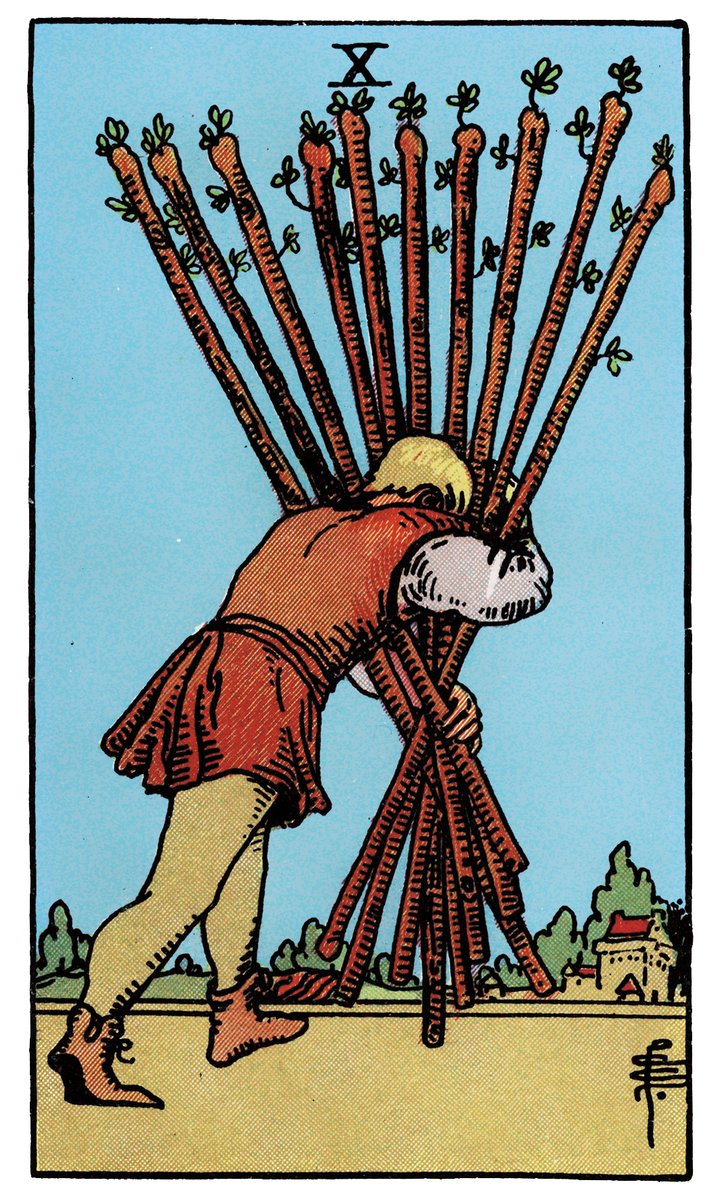
- A figure bends beneath ten bundled wands while approaching buildings, connecting effort with both a destination and a visible cost.
- The bundle obstructs the carrier's view, suggesting that too many duties can make priorities harder to see.
- Upright, the card asks how to complete a demanding phase without treating exhaustion as proof of personal worth.
- Reversed, a burden may be easing, remaining unspoken or becoming difficult to manage without a clearer division of labor.
- Delegation works when responsibility, authority and expectations move together; handing off a task while controlling every detail preserves the strain.
Upright Ten of Wands meaning
The Ten of Wands upright describes responsibility that has accumulated beyond a comfortable carrying capacity. Each wand may represent something worthwhile on its own: a promise, a project or a person who needs help. Together, those commitments leave the figure bent forward with little room to look around. The question is how the whole load functions, rather than whether each individual duty deserves your care.
In love, this can describe one partner managing the calendar, domestic tasks and emotional maintenance while the other sees only the visible chores. Name the full work involved, including remembering and organizing. A useful conversation assigns ownership of recurring tasks rather than requiring the overloaded person to issue instructions every time. The relationship benefits when care becomes a shared practice instead of one person's continuous effort.
At work, the approaching buildings can suggest a demanding final stage, but proximity to completion is an interpretation rather than a promised deadline. Identify what truly must be delivered, which tasks can wait and who can take responsibility for a defined portion. Successful work can generate further obligations; completing everything alone may teach others to expect an unsustainable level of availability. Make the delivery plan reflect actual capacity.
Ten of Wands reversed meaning
The reversed Ten of Wands may describe a deliberate reduction in burden. You finally cancel an unnecessary meeting, transfer an assignment or admit that a deadline needs changing. Relief can feel unfamiliar if being indispensable has become part of your identity. Let a workable handoff count as responsible completion, even when another person uses a method different from yours. The goal is a manageable load, not permanent supervision of every wand.
Alternatively, the reversal can reveal strain that remains hidden. You may insist that things are fine while small errors, resentment and missed commitments accumulate. Before interpreting this as personal failure, examine the amount of work and the support available. Write down the duties that others cannot see. Concrete information gives a conversation about capacity more substance than a general promise to try harder.
A tangled release is another possibility: dropping everything suddenly may shift the same burden onto someone else. Where possible, distinguish what must stop now from what needs a short transition. Explain ownership, dates and unresolved questions. Reversal does not demand endless endurance, but it can ask for enough structure that setting down the bundle creates lasting relief instead of a new round of confusion.
Ten of Wands upright vs reversed by situation
| Situation | Upright | Reversed |
|---|---|---|
| Partnership | Shared life has become unevenly managed | Duties are redistributed or strain stays concealed |
| Career | A demanding delivery needs realistic support | Scope shrinks, handoffs stall or overload becomes visible |
| Home life | Many small obligations form a heavy whole | Unnecessary commitments can be released |
| Personal goals | Completion requires pacing and priorities | Identity tied to overwork needs reconsideration |
The carrier's posture is the useful reference point. A worthy destination does not make every method of reaching it sustainable. Determine whether the next change should reduce the bundle, improve the way it is carried or bring in another person with the authority to help. Different burdens call for different adjustments.
Ten of Wands keywords
| Upright | Reversed |
|---|---|
| Heavy responsibility | Burden released |
| Overcommitment | Strain acknowledged |
| Final effort | Completion delayed |
| Limited perspective | Priorities reorganized |
| Delegation needed | Handoff difficulties |
Translate overload into an inventory you can inspect. List what you are carrying, who expects it and what happens if it waits. This often reveals a mixture of essential responsibilities, inherited habits and optional promises. The image becomes practical when ten indistinguishable wands become separate decisions, each with a reason to keep, share, postpone or put down.
Ten of Wands as advice, outcome and spread positions
As advice, the card favors redesigning the workload before adding determination. In a fictional example, Leila organizes a community exhibition and realizes she is arranging transport, writing labels and answering every volunteer question. She gives one person full responsibility for transport and sets a daily question window. The exhibition still requires effort, but her role no longer absorbs every detail simply because she started the project.
As an outcome, the Ten of Wands can indicate completion accompanied by fatigue or a success that brings more maintenance than expected. Ask what happens after delivery: who handles follow-up, upkeep and new requests? Planning that stage prevents a finish line from becoming the beginning of an even larger bundle. The card can encourage bringing work home safely while questioning whether you should carry the same amount next time.
In a past position, the figure may represent obligations you accepted under earlier circumstances. In the present, identify the task obscuring your view of everything else. As an obstacle, pride in coping alone may prevent support from becoming useful. Beside the Three of Pentacles, compare solitary carrying with coordinated contribution: a team needs explicit roles and usable information, not simply more people standing nearby.
Is the Ten of Wands a yes or no card?
The Ten of Wands usually leans no to taking on another substantial obligation without changing your current load. For finishing an existing commitment, it offers a qualified yes when the remaining work has a clear limit and adequate support. The figure's bent posture asks you to include the cost of carrying in your decision, even if the destination matters deeply.
Reversed, a yes may apply to requesting help, reducing scope or stepping away from an unnecessary duty. Use the yes or no tarot guide to ask about the decision you control. Whether to negotiate a deadline is a more useful question than whether you can endure indefinitely without needing anyone else.
Ten of Wands symbolism in the Rider–Waite–Smith deck
Pamela Colman Smith's carrier gathers all ten wands in front of the body, leaning into their weight while buildings lie ahead. The bundle fills the foreground and interferes with an easy view of the route. This creates a clear visual tension between reaching a destination and preserving the capacity to navigate. The image does not display a reward that would make suffering valuable in itself.
Waite's Ten of Wands entry emphasizes oppression and acknowledges that gain or success can themselves become oppressive. His Pictorial Key to the Tarot also records interpretations that do not neatly agree. This guide develops the workload theme through practical questions about delegation and completion; those applications are modern readings, while the burden created by achievement has a direct historical basis.
Frequently asked questions about the Ten of Wands
Does the Ten of Wands mean I should quit?
It asks you to assess the load before deciding whether to continue, reduce scope or leave. Some duties can be completed with support; others may no longer justify their cost. Identify the specific commitments and available options instead of treating one heavy image as an instruction to abandon everything.
What does the Ten of Wands mean in a relationship?
One person may feel responsible for keeping the relationship or household functioning. Discuss the work behind the visible results, including planning and remembering. The card becomes useful when both people can name their responsibilities and negotiate a division that does not depend on constant reminders from the more burdened partner.
Is the reversed Ten of Wands positive?
It can be, particularly when it reflects an honest request for help or the release of an unnecessary obligation. It may also reveal a handoff that needs repair. Judge the reversal by whether responsibilities become clearer and more manageable, rather than assuming that relief happens automatically when the card turns upside down.
Can this card describe successful work?
Yes, because achievement often creates maintenance, expectations and follow-up duties. A flourishing project can become difficult to carry when all decisions still pass through one person. Review the operating arrangement after a success so that growth includes support and clear ownership as well as additional demand.
What should I do first when I feel overloaded?
Choose one concrete part of the bundle to examine today. Clarify its deadline, reduce an unnecessary step or ask someone to own a defined portion. A specific adjustment can restore enough perspective to plan the rest, while a vague resolution to become more efficient may leave the same weight in place.
What does Ten of Wands mean for you?
Already have this card? Choose its orientation and add your question. We’ll interpret this exact card in context, without drawing a different one.
One personalized interpretation uses one free reading. Subscribers get unlimited readings, follow-up questions, and supplemental cards. Your reading stays private.
Ten of Wands
For reflection and personal insight. Your choices shape what comes next.
A question to take with you
A responsibility can outgrow its purpose; review what can be shared, simplified or set down. Where would a more deliberate use of my energy help?
Explore a question with the cards →These are contemporary reflection prompts, not a single definitive meaning. For historical background, see A. E. Waite’s The Pictorial Key to the Tarot. Interpretations vary with the reader and the context.