 Fate & Stars
Queen of Swords tarot card meaning
Queen of Swords meaning at a glance
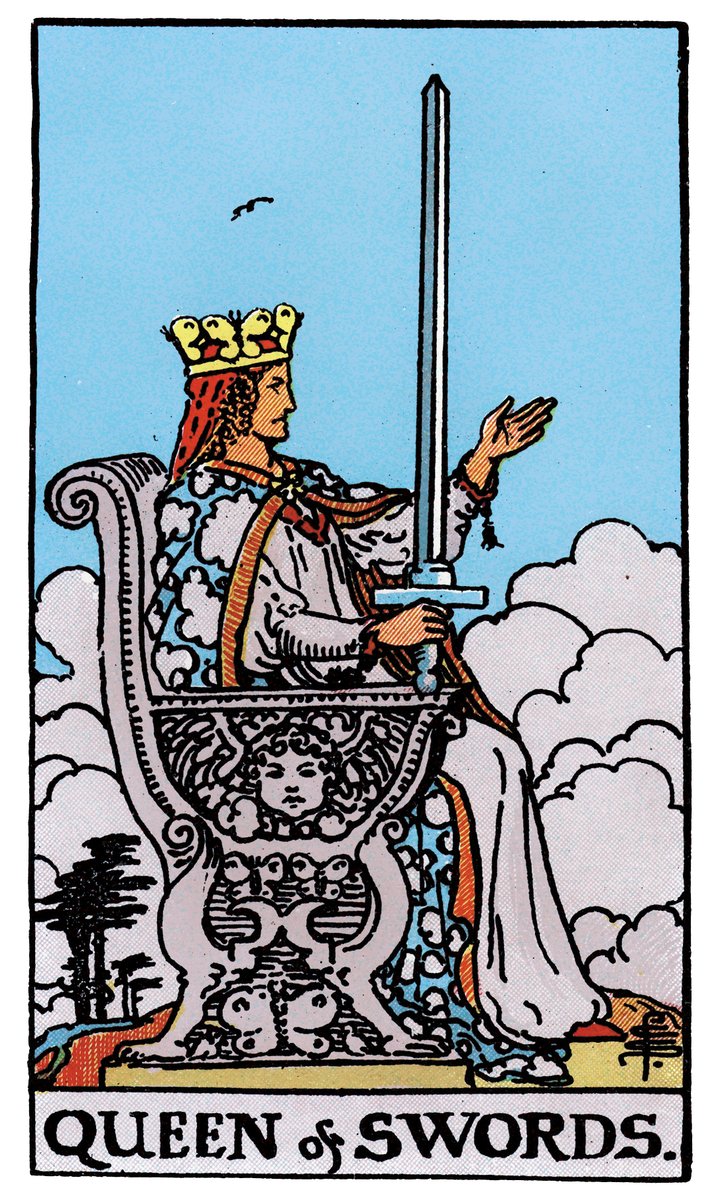
The Queen of Swords means discernment, honest boundaries and clear speech informed by experience. Her raised sword defines a standard while her extended hand leaves room for conversation. Upright, be direct and receptive; reversed, examine guardedness, tangled communication or an overly sharp response. Clarity does not require becoming bitter or unkind.
Things You Should Know
- The queen's vertical sword suggests a clear distinction: name what is acceptable, accurate or necessary without hiding behind hints.
- Her other hand reaches outward, pairing firm judgment with an invitation to speak and be heard.
- Clouds beneath the open sky offer a visual language for complicated experience that can inform, rather than permanently darken, judgment.
- Reversed, the raised blade may become defensive sharpness, or a needed boundary may remain difficult to express.
- The seated queen's composure supports self-respect after experience; the image does not require a story of bitterness or inevitable isolation.
Upright Queen of Swords meaning
The Queen of Swords upright asks you to make a distinction you can explain clearly. Her sword stands straight, but her empty hand extends toward the space in front of her. Together, these gestures suggest that a boundary and a conversation can coexist. You can hear a person's reasons without accepting their request, and you can correct an error without turning the exchange into a contest over who deserves respect.
In love, the extended hand encourages honest questions about what each person can offer. The raised blade may represent a limit around communication, exclusivity or time together. State the limit in terms of your own choices: what you will participate in and what you need to step away from. The queen's composed seat favors a plain answer over a test that requires a partner to decode your silence.
At work, the blade can resemble an editor's precise cut through ambiguity. Ask which claim needs support, which deadline is real and which responsibility has no owner. Her open hand keeps critique connected to collaboration: invite the information you may have missed. The clouds behind her suggest that experience has a place in judgment, but a familiar difficulty should still be examined on its present facts rather than treated as an exact repeat.
Queen of Swords reversed meaning
Reversed, the Queen of Swords can describe a useful boundary caught in a painful delivery. The raised blade may arrive before the extended hand, so a reasonable request sounds like a verdict already passed. If you need more notice before visitors arrive, say that directly instead of attacking someone's character. The distinction remains valid even when the language used to defend it needs repair.
The reversal can also point toward a boundary that never reaches speech. You may keep the queen's sword inward, cutting down your own objections before anyone else hears them. Her outstretched hand then becomes a reminder that conversation requires your contribution too. Write the essential sentence, remove the imagined argument around it and practice saying it without supplying a long defense of your right to have a preference.
Another reversed expression is judging today's interaction entirely through yesterday's disappointment. The clouds around the throne can suggest experience obscuring a new view. Look for a concrete similarity and a concrete difference before deciding how to respond. This does not require ignoring a real pattern. It asks that the queen's discernment remain responsive, so past learning protects you without making every unfamiliar person answer for someone else's behavior.
Queen of Swords upright vs reversed by situation
| Situation | Upright | Reversed |
|---|---|---|
| Love | Direct needs and respectful limits | Defensive wording or a boundary left unspoken |
| Career | Precise feedback and independent assessment | Excessive criticism or reluctance to challenge confusion |
| Daily life | Experience informs a proportionate response | Old disappointment narrows the present view |
Read the queen's two hands together when comparing these possibilities. The sword supplies the distinction; the open palm allows exchange. If one gesture dominates, ask what the other would contribute. A reversed reading can improve simply through a clearer sentence or a better moment to speak, without requiring a dramatic break from the relationship or situation.
Queen of Swords keywords
| Upright | Reversed |
|---|---|
| Discernment | Judgment clouded |
| Honest boundaries | Boundaries withheld |
| Clear speech | Defensive sharpness |
| Independent thought | Distrust examined |
| Experienced perspective | Past hurt revisited |
Bring each keyword back to the raised sword and extended hand. Clear speech means choosing an accurate statement that another person can understand, while independence means assessing a claim for yourself. Neither requires the queen to reject every offer. Her open palm offers a useful test: can your chosen boundary coexist with curiosity about what the other person actually means?
Queen of Swords as advice, outcome and spread positions
As advice, the queen asks for a sentence that carries both firmness and openness. In a fictional example, Elena's neighbor repeatedly requests last-minute favors. Elena says she can occasionally help with advance notice but cannot keep changing evening plans. She offers a way to ask without promising an automatic yes. The sword defines her availability, while the extended hand preserves a workable relationship.
As an outcome, the vertical blade may suggest that ambiguity becomes easier to name. You could reach an explicit agreement, receive candid feedback or recognize a limit you can maintain. The seated figure does not guarantee an ending or a reconciliation. A constructive result may simply be understanding where you stand and allowing another person to make their own choice in response to your clarity.
In a past position, the clouds behind the queen can describe an experience that taught you to ask sharper questions. In the present, balance that learning with the openness of her hand. As an obstacle, the sword may represent critique that arrives before sufficient listening. Beside the King of Swords, distinguish a personal boundary from a rule governing a group: her direct exchange and his settled authority operate at different scales of responsibility.
Is the Queen of Swords a yes or no card?
The Queen of Swords offers a qualified yes to honest communication, independent evaluation and a clearly stated boundary. Her upright blade favors a choice you can describe without disguising your reasons. For a question about tolerating repeated ambiguity or accepting an arrangement you cannot sustain, her answer may lean no. The extended hand asks you to clarify the terms before assuming that rejection is the only available response.
Reversed, the queen's sharp silhouette suggests waiting until your wording matches your intention. Use the yes or no tarot guide to focus on a practical action, such as asking one direct question. Her sword cannot decide whether someone will react well, but it can prompt you to communicate a limit that is yours to set.
Queen of Swords symbolism in the Rider–Waite–Smith deck
Smith depicts the queen with a sword raised vertically, her free hand extended and clouds surrounding the lower sky. In Waite's Queen of Swords entry, her expression is connected with experience of sorrow, and the historical meanings emphasize loss and separation. Those associations explain part of the tradition; they do not establish that the figure must be bitter, widowed or destined for loneliness in a contemporary reading.
This guide interprets the relationship between sword and hand as a balance of discernment and receptive communication. The clouded background can suggest lived complexity, while the space ahead of her allows a response still to be heard. These are modern applications drawn from the visible scene rather than a claim that Waite used today's language of boundaries. The image supports learning from experience while retaining the ability to distinguish one situation from another.
Frequently asked questions about the Queen of Swords
Is the Queen of Swords a negative card for love?
The raised sword can feel uncompromising, but the queen also extends a welcoming hand. In love, that combination may support a relationship through honest expectations and respect for separate needs. Difficulty arises when clarity becomes contempt or when a needed boundary stays silent. Judge the actual exchange rather than treating the blade as a prediction of rejection.
Does the Queen of Swords always represent a divorced woman?
No. Waite's historical associations include separation and sorrow, but the seated figure can represent discernment in a person of any gender or relationship history. Her experienced expression invites attention to what has been learned. It does not provide a biography, and the sword cannot establish someone's marital status from a reading alone.
What does the Queen of Swords reversed mean for communication?
The sword and open hand may have fallen out of balance. You might be answering defensively before understanding a question, or keeping your own position so guarded that nobody can respond to it. Try naming the issue in one neutral sentence. Then restore the queen's outward gesture by leaving genuine space for an answer.
How is the Queen of Swords different from the Page of Swords?
The queen sits with an upright blade and an extended hand, suggesting a considered distinction expressed through experience. The page stands in windy conditions with a sword held ready, emphasizing inquiry and alert learning. Her question often concerns what limit to communicate; his concerns what information to investigate before deciding what he knows.
What is the Queen of Swords asking me to release?
Look at the clouds around her throne and ask whether an old explanation still fits today's circumstances. You may need to release an expectation that others should infer your limits, or a habit of treating every request as pressure. Keep the sword's clarity while opening the hand enough to assess the present interaction on its own terms.
What does Queen of Swords mean for you?
Already have this card? Choose its orientation and add your question. We’ll interpret this exact card in context, without drawing a different one.
One personalized interpretation uses one free reading. Subscribers get unlimited readings, follow-up questions, and supplemental cards. Your reading stays private.
Queen of Swords
For reflection and personal insight. Your choices shape what comes next.
A question to take with you
Honest discernment can coexist with openness; communicate a boundary without turning it into contempt. Which assumption could I check against observable evidence?
Explore a question with the cards →These are contemporary reflection prompts, not a single definitive meaning. For historical background, see A. E. Waite’s The Pictorial Key to the Tarot. Interpretations vary with the reader and the context.