 Fate & Stars
Two of Swords tarot card meaning
Two of Swords meaning at a glance
The Two of Swords depicts a guarded pause: two competing positions held in balance while a choice remains unmade. The blindfolded figure suggests limited information or deliberate withdrawal from feeling. Upright, examine the stalemate; reversed, new information may thaw it, or pressure may force a decision before you feel fully ready.
Things You Should Know
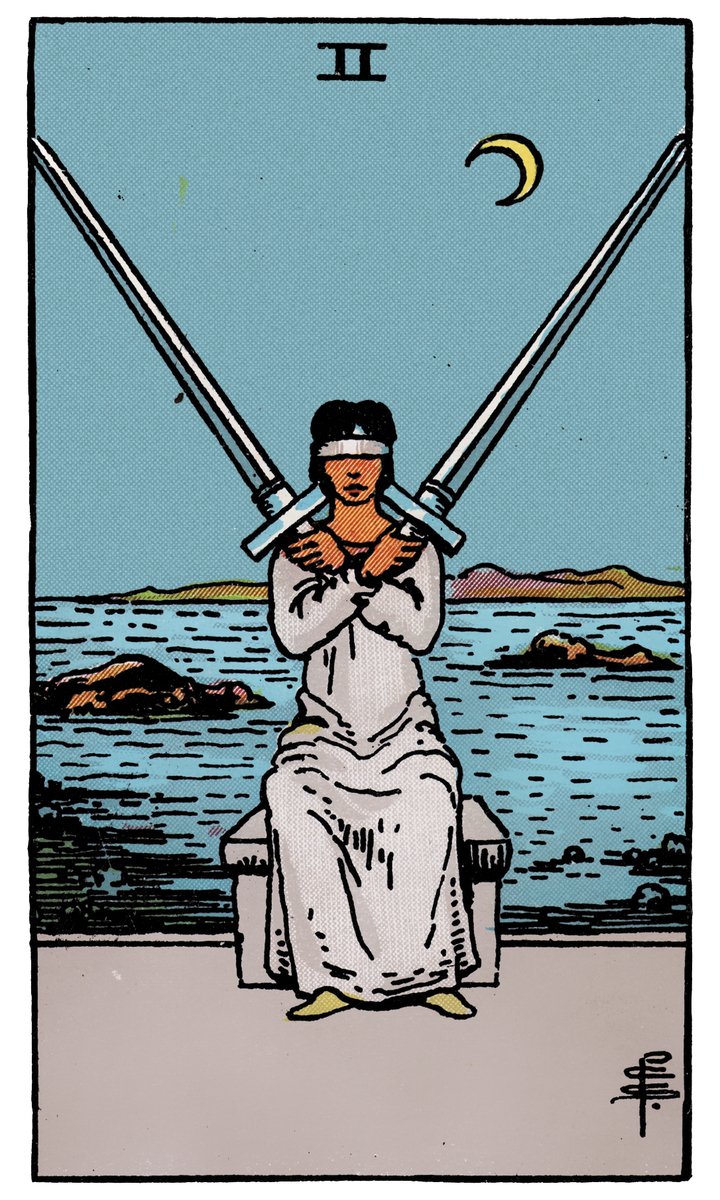
- A seated, blindfolded figure crosses two swords over the chest, with water, rocks and a crescent moon behind.
- Upright, the card can describe a truce, guarded emotions or a choice postponed to preserve fragile balance.
- The blindfold asks what remains unseen, including information you lack and feelings you have set aside.
- Reversed, the deadlock may break through honest discussion, clearer facts or mounting pressure to choose.
- A pause becomes useful when it has a purpose and a review point; indefinite avoidance keeps both swords raised.
Upright Two of Swords meaning
The Two of Swords upright often appears when two positions seem evenly matched or when accepting either one feels costly. You may be keeping the peace by declining to state what you think. The crossed blades create a barrier around the chest: intellectual balance may be protecting something emotionally vulnerable. Before asking which option is objectively correct, identify what each choice would require you to admit, lose or disappoint.
In love, this can describe a conversation neither person wants to begin. A couple may agree on everyday matters while carefully avoiding a question about commitment or where to live. For someone dating, uncertainty may involve mixed information rather than a lack of feeling. State what you know and ask one direct question. Temporary space can support honesty, provided both people understand when they will return to the discussion.
At work, competing proposals may remain in a tie because nobody has agreed on the deciding criterion. More debate will not necessarily help if one person values speed and another values control. Name those priorities and determine who owns the decision. If a fact is missing, specify it rather than requesting endless additional research. The card can support a measured pause while that fact is obtained.
In personal reflection, notice where neutrality is useful and where it has become a posture you must constantly defend. You do not need to have a strong opinion on everything. However, refusing to acknowledge your own preference can leave other people making choices on your behalf. Lowering the swords begins with admitting what matters, even before you know exactly how to act on it.
Two of Swords reversed meaning
The Two of Swords reversed can describe a stalemate beginning to thaw. A direct answer arrives, an assumption is corrected or you finally recognize the preference hidden beneath your balanced arguments. This release may feel awkward rather than immediately peaceful. Once the barrier drops, feelings and practical consequences become harder to keep separate. Give yourself room to process them without recreating the old impasse simply because uncertainty felt familiar.
Another expression is a decision forced by accumulated delay. A deadline arrives while two options still seem uncomfortable, or someone else acts because no agreement was reached. Instead of treating this as punishment, identify what remains within your influence. You may still negotiate timing, ask for clarification or choose how to communicate your response. The reversal invites participation in an imperfect decision rather than waiting for all tension to disappear.
In relationships, too much incoming advice can make the blindfold feel tighter. Separate your own experience from friends' competing interpretations. At work, reduce the problem to the actual choice and the evidence that could change it. The reversal is constructive when information becomes usable, not merely abundant. One trustworthy answer may restore more movement than ten speculative opinions, especially if the real obstacle has been reluctance to name an emotional stake.
Two of Swords upright vs reversed by situation
| Situation | Upright | Reversed |
|---|---|---|
| Love | Guarded feelings or an uneasy agreement to avoid a subject | Honest disclosure, emotional thaw or a decision under pressure |
| Work | Two proposals stalled without a shared deciding criterion | Clarifying evidence or a deadline ending the tie |
| Friendship | Neutrality maintained between competing loyalties | A boundary stated or the cost of staying silent revealed |
| Personal growth | Protecting equilibrium while examining a difficult choice | Recognizing a preference and tolerating imperfect certainty |
Ask whether the pause is producing understanding. If each week brings the same circular discussion, another delay may preserve the barrier rather than improve the decision. If a specific answer is expected tomorrow, waiting can be purposeful. The difference lies in what the pause makes possible and whether anyone has agreed on its limits.
Two of Swords keywords
| Upright | Reversed |
|---|---|
| Stalemate | Breaking the deadlock |
| Guarded emotions | Emotional thaw |
| Postponed choice | Forced decision |
| Fragile truce | Clarifying information |
| Deliberate pause | Overloaded judgment |
Treat guardedness as something to understand before trying to remove it. You may be protecting privacy, preventing escalation or buying time to think. Write down what the crossed swords are keeping out and what they are keeping in. A boundary can remain useful even when a particular avoidance strategy has stopped helping you choose.
Two of Swords as advice, outcome and spread positions
As advice, the Two of Swords asks for a decision process that can hold both facts and feelings. In a fictional example, Jonah cannot choose between staying with his current team and transferring to a new one. He keeps comparing job titles while avoiding the real concern: he does not want to disappoint his manager. Naming that loyalty allows him to ask about the new role's duties and discuss a respectful handover. The decision becomes clearer without either option becoming flawless.
As an outcome, the card can suggest a continued pause if nobody changes the conversation. That need not mean permanent failure. A scheduled review, an agreed criterion or one candid statement can alter the pattern. In a relationship spread, consider whether both people are choosing the pause or whether one person's silence is controlling its duration. Balance requires some shared understanding of what is being held and why.
In the past, this figure may describe an old habit of keeping conflicting needs at a distance. In the present, ask which question you have avoided putting into words. As an obstacle, apparent neutrality may conceal fear of disagreement. Beside the Two of Wands, the card distinguishes blocked judgment from purposeful planning; beside the Queen of Swords, it can encourage clear questions and explicit boundaries. These combinations offer ways to approach the decision, rather than a substitute for making it yourself.
Two of Swords Yes or No
Upright: Maybe — a guarded stalemate leaves the decisive information or agreement unresolved.
Reversed: Maybe — the deadlock may break, but pressure to choose does not make either option sound.
The Two of Swords offers a pause for discernment rather than a concealed yes. If you are choosing whether to contact someone, accept an offer or make a commitment, identify what remains unknown and set a time to revisit it. Avoid drawing repeatedly until the uncertainty becomes a preferred answer.
For a Two of Swords reversed yes or no reading, notice whether new facts have arrived or you simply cannot postpone the conversation any longer. Those are different reasons to act. Try the yes or no tarot guide with a bounded question such as whether to request clarification today. The crossed blades do not promise agreement from the other person.
Two of Swords in Love
Singles
The Two of Swords can describe attraction held at a distance because choosing feels exposing. You might be comparing two people, deciding whether to date at all or avoiding a question about availability. Give yourself a clear decision process: what do you need to know, and can you ask it respectfully? Silence from someone else remains silence; it does not establish secret feelings underneath their reserve.
Partnered
In a couple, an uneasy truce may protect a peaceful evening while postponing an important disagreement. Choose a time when both people can speak and identify one issue rather than reopening every argument. Each partner can describe what they are trying to protect before proposing a solution. A love tarot reading can prompt that discussion, but neither partner should use a card as the deciding vote.
Reversed
Reversed, the guarded conversation may finally open, or accumulated pressure may spill out as rushed ultimatums. Slow the exchange enough to separate new information from fear of losing the relationship. If your feelings remain uncertain, state the limit honestly instead of offering reassurance you cannot maintain. Movement beyond the stalemate may lead to a workable agreement or a respectful refusal; clarity is useful even when it is uncomfortable.
Two of Swords symbolism in the Rider–Waite–Smith deck
Pamela Colman Smith places a blindfolded figure on a stone seat, holding crossed swords in front of the upper body. Water and rocky outcrops lie behind, with a crescent moon overhead. The pose appears balanced but effortful: maintaining the barrier requires continued participation. A contemporary reading can connect the unseen water with feelings or circumstances excluded from conscious deliberation, while the moon reinforces the scene's partial visibility.
Waite's Two of Swords entry is a historical reference for the image and its older associations, including equilibrium and qualified harmony. The emphasis here on postponed choice and guarded emotion is a reflective interpretation of the composition. It should not be used to claim that a particular person is hiding a secret; the blindfold can equally represent uncertainty, privacy or your own incomplete view.
Frequently asked questions about the Two of Swords
Does the Two of Swords mean I should do nothing?
It can support a deliberate pause if that pause serves a clear purpose. Decide what you need to learn and when you will reassess. If nothing is expected to change, remaining motionless may simply extend the discomfort and allow a deadline or another person to determine the outcome.
Can this card describe someone's feelings?
It may suggest difficulty expressing or sorting feelings, but it cannot reveal another person's private emotional state. Ask what they are willing to discuss and pay attention to their stated boundaries. The crossed swords are a useful prompt for communication, not proof that a hidden attraction exists.
Is the Two of Swords reversed a positive card?
The reversal can be welcome when information arrives or a difficult conversation finally begins. It can also feel stressful when a decision becomes unavoidable. Judge the shift by whether it makes an honest, workable response possible, rather than expecting the end of a stalemate to remove every cost.
How does the Two differ from the Eight of Swords?
The Two centers on holding competing positions in suspension, often through guardedness or an uneasy truce. The Eight emphasizes perceived restriction and difficulty seeing available movement. In the Two, identify the choice being balanced; in the Eight, investigate which limits are real and which may be reconsidered.
Is the Two of Swords reversed yes or no?
It remains a maybe while the consequences of breaking the stalemate are unclear. New information may make a choice possible, but pressure alone does not make it wise. Ask which fact or honest conversation would let you choose deliberately rather than simply escape the discomfort of waiting.
What does Two of Swords mean for you?
Already have this card? Choose its orientation and add your question. We’ll interpret this exact card in context, without drawing a different one.
One personalized interpretation uses one free reading. Subscribers get unlimited readings, follow-up questions, and supplemental cards. Your reading stays private.
Two of Swords
For reflection and personal insight. Your choices shape what comes next.
A question to take with you
A stalemate may protect you from an uncomfortable choice, but identifying the missing information can help you move. Which assumption could I check against observable evidence?
Explore a question with the cards →These are contemporary reflection prompts, not a single definitive meaning. For historical background, see A. E. Waite’s The Pictorial Key to the Tarot. Interpretations vary with the reader and the context.